










































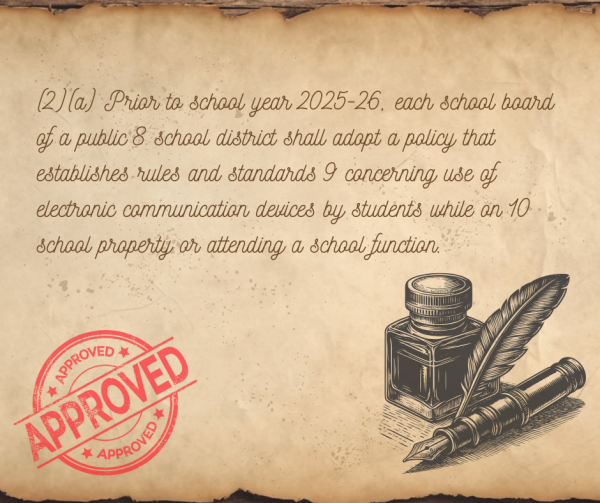
This past spring, the Nebraska Legislature passed a law prohibiting the use of electronic devices at school during instructional time. Legislative Bill 140 requires each public school district to adopt a policy establishing standards for student device use at school functions or on school property. Many districts have adopted similar policies in response to the law, though some differences remain.
The Fremont High School student handbook states:
“Electronic devices may not be used during class time except when specifically approved in advance by a school building administrator in conjunction with appropriate and authorized class or school activities or events (i.e., student use of a cellphone to participate in an online quiz; student use of a laptop computer for a class presentation, etc.).”
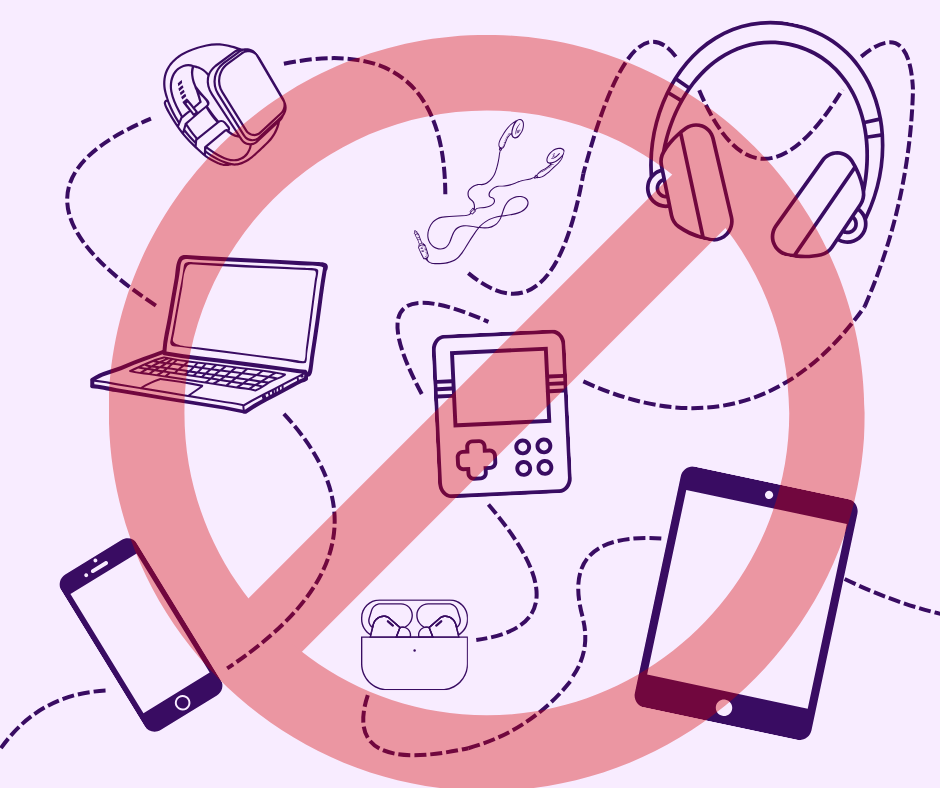
According to the law, electronic devices include “any device which transmits by electronic means any writing, sound, visual image, or data of any nature to another electronic communication device. An electronic communication device includes a cellphone.” This definition covers items such as cellphones, tablets, laptops, earbuds, digital watches, headphones, AirPods, video game devices and other battery-powered or electronic instruments that transmit text, voice or data.
Under the Fremont policy, violations result in students turning in devices to a designated area for the rest of class. Teachers record the incident as a minor technology violation. If a student refuses, the incident is documented as a major defiance violation, and an administrator is called. Continued refusal results in parents being notified to either pick up the device or have the student go home.
Fremont High students said they first learned about the policy at the start of the school year.
“I first heard about the law on the first day of school,” freshman Maria Alonzo Gutierrez said.
Some Fremont High students said they support the policy because it helps reduce distractions during class.
“I support the idea because that way, people can get their work done with no distractions,” junior Roberto Perez said.
Students said the absence of cellphones has increased focus in many Fremont High classrooms.
“The new law has been helpful in most of my classes; a majority of my classmates pay more attention during class,” Gutierrez said.
Some students, however, said they disagree with how the policy applies during TST.
“I heard last year that they would let students be on their phones during TST,” Gutierrez said. “Now they can’t, which I find unfair since many students do finish their homework, and they should be allowed to have time on their phones.”
Despite reported benefits, some students said they do not expect the policy to remain permanent.
“I think over the year, some action will take place which will remove the policy,” Gutierrez said.
The Gretna Public Schools district, a neighboring school system, outlines a similar policy. Students must place devices in classroom “caddies” at the beginning of class. They may use devices before and after school, during lunch and during passing periods, but not during bathroom breaks. Unlike Fremont, Gretna allows listening devices, such as headphones and AirPods, in one ear when permitted by staff.
Consequences for violating Gretna’s policy escalate with repeated offenses. The first violation results in the device being held in the office until the end of the day. A second violation results in one hour of detention. A third offense results in two hours of detention after school, with the device being held until a parent picks it up.
Other schools across the country have also enacted restrictions. In Texas, House Bill 1481 requires all districts to prohibit the use of personal communication devices on school property during the school day. Some schools, such as Lake Highlands High School and Pearce High School, use Yondr pouches — lockable pouches that secure devices during the day. Students carry the pouches but cannot access their devices.
Before entering school, students must power off devices and place them in their Yondr pouch. The pouches remain locked throughout the day. At dismissal, students unlock them at a base station and store the pouch in their backpack. Students are responsible for keeping track of their pouches.
Fremont administrators said the district considered several approaches before finalizing its policy.
“We had no plans to use the Yondr pouches,” Fremont High School Principal Myron Sikora said. “I’m not saying it’s 100% off the table, but we have not looked into using the Yondr pouches.”





Maily Calderon • May 4, 2026 at 2:49 pm
I think that the new phone law should not be enforced. Yes, I do think phones are a distraction during class, but I think teachers were already handling that beforehand from what I have expericenced in school before the law became enforced. Now, with the multiple lockdown scares we got as well, just only makes me disagree more that we should have a phone ban. I’d at least would like to have one small guarantee of my safety rather than it being taken away because of the law.