






























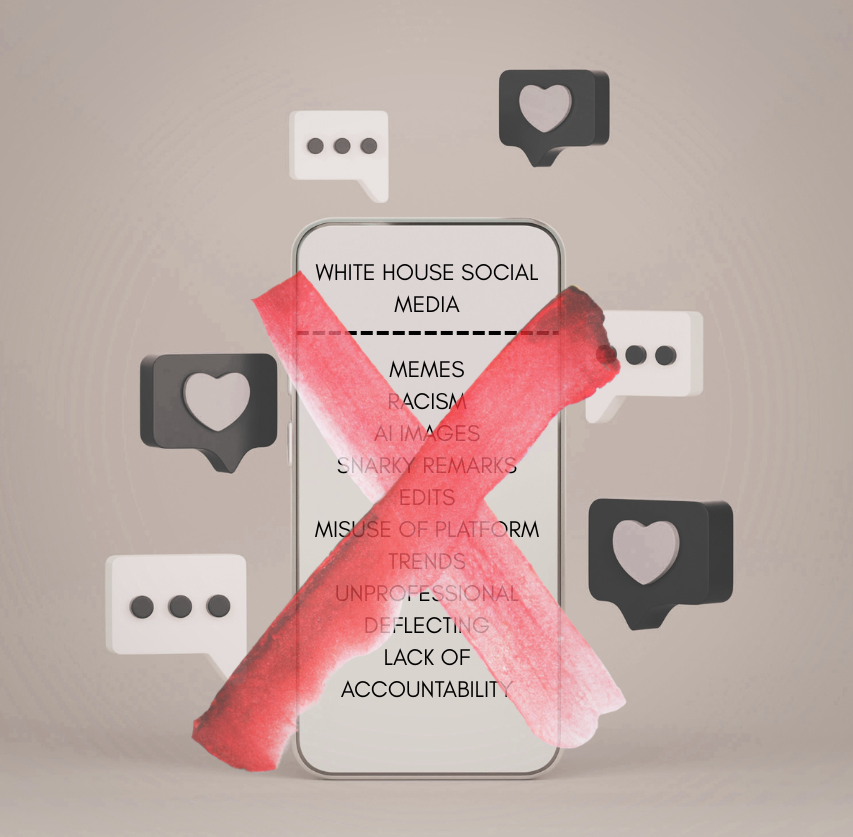
In a period where social media has become a major form of communication and news outlets heavily influence what people see, believe and trust, it makes sense that the U.S. government wants to meet the public where they stand. However, there is a distinct difference between being accessible and sacrificing professionalism for the sake of popularity. The official White House TikTok, Instagram and X (formally known as Twitter) accounts seem far more interested in chasing trends than in upholding the professionalism their role requires.
A government social media page should not resemble a brand account attempting to go viral or profit off likes, shares, comments and views. It represents national decisions that affect real people, and the way the accounts are being handled is alarming. Using memes, trending audios out of context, and making jokes about situations that clearly call for care and respect through short video clips is unprofessional and deeply concerning.
One example that sparked widespread controversy involved a TikTok posted on the official account using the popular “Nothing beats a Jet2 Holiday” audio while showing a group of immigrants being escorted onto a plane in cuffs and chains. Another clip featuring people in handcuffs was paired with the song “Big Boy” by SZA, with the lyrics “It’s cuffing season” displayed over the clip. Not only was the song taken completely out of context, but its use was wildly inappropriate given the seriousness of the situation and the authority the account represents.
Comedic relief is a common accompaniment with strange or uncomfortable situations, but whose role is it to provide relief when there is nothing relieving about watching people be restrained and removed in handcuffs? Even when some agree with the actions being taken in regards to deportation of immigrants who crossed the border illegally, the methods of documentation do not require such dehumanizing and inconsiderate manners.
This issue goes even further when artists themselves are compelled to speak out against the way their music is being used. In an edit capturing the arrest and detention of immigrants once again, Olivia Rodrigo and her music were involved. Rodrigo later spoke out on X, stating that the administration should never use her music again.
“Don’t ever use my songs to promote your racist, hateful propaganda,” Rodrigo said. The audio was cut from the video soon after.
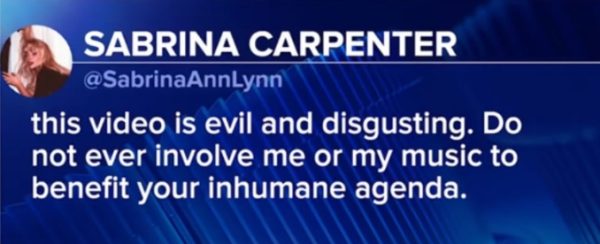
A similar situation occurred just a month later, however. This time with Sabrina Carpenter and her song Juno. After the video circulated, Carpenter publicly criticized the White House for associating her work with their actions on X as well.
“This video is evil and disgusting. Do not ever involve me or my music to benefit your inhumane agenda,” Carpenter said.
The response escalated the situation rather than addressing the artist’s concerns. Rather than acknowledging her concerns, White House spokesperson Abigail Jackson responded by referencing Carpenter’s album title and lyrics from her song “Manchild.”
“Here’s a Short ‘n Sweet message for Sabrina Carpenter: we won’t apologize for deporting dangerous criminal illegal murderers, rapists, and pedophiles from our country. Anyone who would defend these sick monsters must be stupid, or is it slow?” Jackson said.
These aren’t the only people who have expressed their dissatisfaction with having their music chosen. When multiple artists begin publicly condemning the White House for attaching their work to videos with dehumanizing situations, it becomes clear the account has crossed a line—if the actions themselves hadn’t done so already.
And when exploitation of real situations, real artists and real people still failed to satisfy the White House’s online presence, they went as far as turning to AI-generated content that further distances the government from authenticity, responsibility and professionalism.
Trump further blurred the line between official leadership and online provocation when he promoted an AI-generated video during the nationwide No Kings protest. The video depicted the president flying over a crowd of protesters in a jet while he dumped what appeared to be sewage on them—a crude and demeaning portrayal of citizens exercising their right to protest. One protester, Harry Sisson, responded to the matter requesting a reporter to ask why the video was posted. Vice President JD Vance claimed he’d look into it, only to offer no response.
Extending beyond political influence, Kenny Loggins, whose song was played over the 19-second clip, responded in similar sentiment to previous artists. Unlike the administration, Loggins’ statement was profound and encouraging as he emphasized unity and values.
“I can’t imagine why anybody would want their music used or associated with something created with the sole purpose of dividing us,” Loggins said. “Too many people are trying to tear us apart, and we need to find new ways to come together. We’re all Americans, and we’re all patriotic. There is no ‘us and them’ — that’s not who we are, nor is it what we should be. It’s all of us. We’re in this together, and it is my hope that we can embrace music as a way of celebrating and uniting each and every one of us.”
The use of AI did not stop at the attempts of symbolic imagery or satire. It soon escalated into a deliberate distortion of a real person’s face, crossing the line from poor judgment to outright humiliation and targeting.
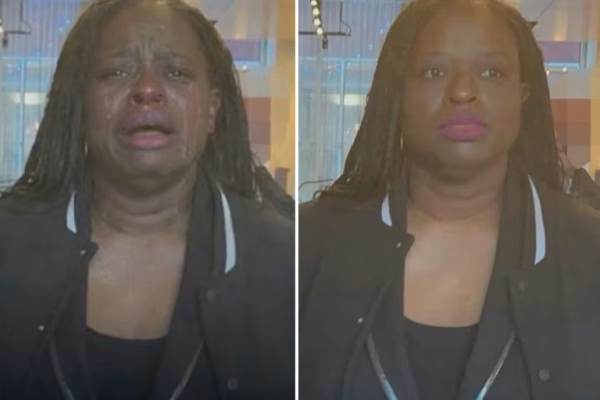
Following an anti-ICE protest organized by Nekima Levy Armstrong, the White House shared a photo of the woman who had been arrested. The photo was digitally altered to make her face appear as though she were hysterically crying— there was no warning or label of this action. The post reflected no restraint, remorse or acknowledgement of the ethical implications of manipulating a real person’s image using AI, demonstrating a troubling disregard for both ethical standards and the responsibility of a government platform.
Their response? Not far off from the others in terms of carelessness and lack of accountability.
“YET AGAIN to the people who feel the need to reflexively defend perpetrators of heinous crimes in our country I share with you this message: Enforcement of the law will continue. The memes will continue. Thank you for your attention to this matter,” deputy communications director Kaelan Dorr said.
While some AI-generated posts have leaned towards hostility and humiliation, others take a more subtle approach, yet the implications remain the same.
In one of the White House’s videos, President Trump is shown holding hands with a penguin with an American flag gripped in the penguin’s flipper. The two are walking toward the Greenland flag across a frozen, glacier-like landscape. At first glance, this post appears harmless. There is no mockery, no explicit hostility and no apparent target. Nevertheless, there is a deliberate spread of fabricated imagery by an official account. Penguins are not native to Greenland, so tying the imagery to what was meant to be Greenland remains factually inaccurate.

The White House should not have such social media platforms designed to dehumanize, provoke outrage or dictate loyalty to a president through edits and memes. Regardless of who holds office or official government positions, these platforms are meant to inform the public— not mock it, manipulate it or turn human suffering into content. While social media has become a universal form of sharing information, the purpose is lost when engagement is prioritized over empathy and truth.
If controversy and insensitivity are the only ways these accounts can capture attention, what good could they really be doing? Even more concerning is the irony of a government publicly shaming the very people it is meant to represent. The government is meant to defend its people and uphold human dignity. When leadership resorts to spectacle rather than professionalism and respect, it is not accessibility or power on display, but a profound failure of trust and responsibility.


Alexa Rasmussen • Apr 30, 2026 at 9:28 pm
This is so inspiring
Madelyn • Apr 30, 2026 at 3:04 pm
The use of viral humor on official accounts—such as that of the White House—carries the risk of undermining public trust by trivializing serious human situations.
AB • Apr 30, 2026 at 1:04 pm
Ironic that the highest level leadership is so immature.