





































Every day, millions of teens open their phones intending to check “just one thing,” only to look up and realize an hour has passed. It’s a cycle so common that most people don’t even question it anymore. But behind that habit is something far more powerful than willpower: a chemical response in the brain that keeps us coming back again and again.
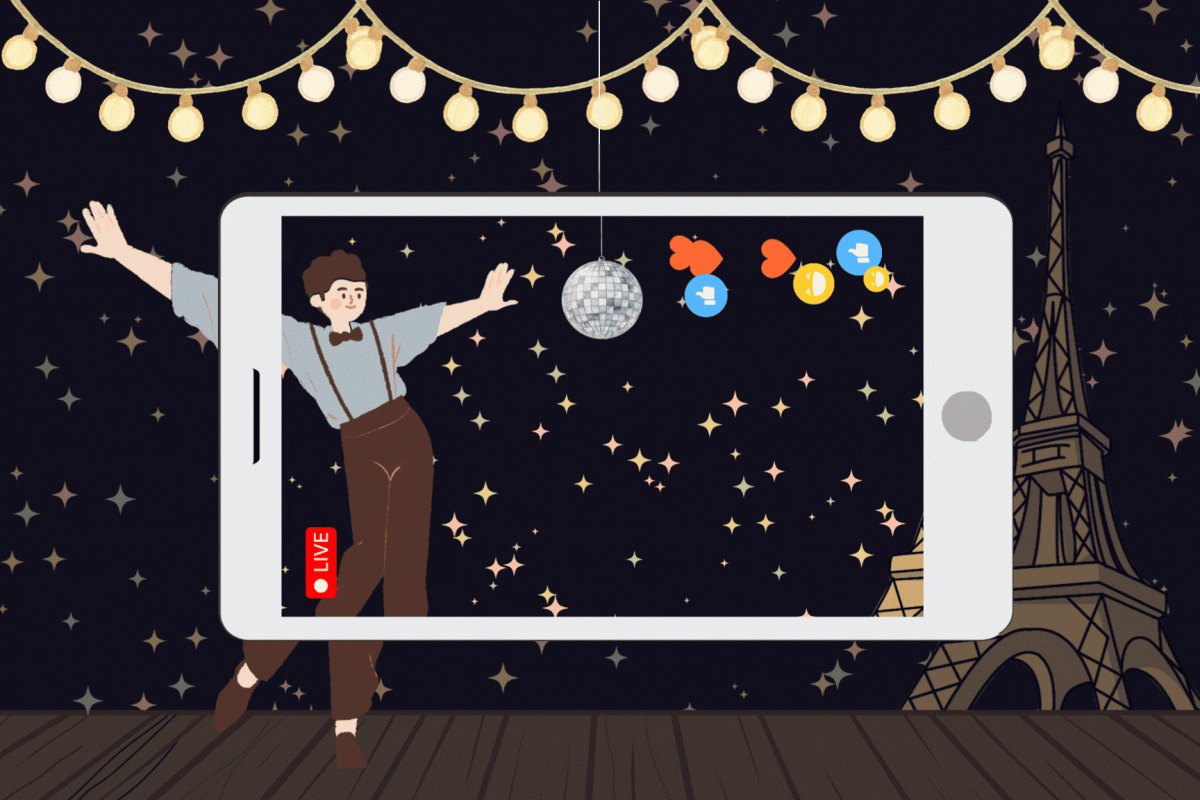
Studies have shown that the amounts of dopamine being released are the same amounts released when the human body is addicted to drugs or alcohol. That constant “high” of always refreshing the page or tapping through someone’s story is the exact thing that keeps us all coming back for more. Whether you like it or not, everyone knows social media is not the healthiest thing mankind has ever created. The question, though, is simple: why do we love it? It’s no secret that social media is extremely addictive. While most people claim they don’t need it, they catch themselves scrolling late into the night. The reason we become almost personally attached to social media is due to the large amount of dopamine released into our brains.
Some would argue that social media isn’t beneficial for anyone, regardless of age; however, most people agree that it is especially detrimental to teenagers. In fact, hundreds, if not thousands, of studies have been done to prove this. A recent one, completed by Penn State University in early 2025, shows that nearly half of teen social media users agree that social media can very easily become unhealthy. Many countries are putting heavy restrictions on minors’ use of social media. Some, such as Australia, have even gone as far as banning all children under the age of 16 from having accounts on many well-known platforms, including Instagram, Twitter (or X), and TikTok. These bans have led to significant backlash.
Recent studies have shown that a little over 90% of teens ages 13–17 use social media daily. Of course, not all social media is bad, and not everyone who uses it has malicious intentions. Just like anything, though, there will always be people who make the wrong decisions. Many things occur on social media sites that have a negative impact on adolescents, one of these being cyberbullying. There’s been cyberbullying since social media was invented. This isn’t a new problem, but there’s just so much gray area surrounding it that it’s hard for anything to change. Whether it’s being bullied, harassed, or experiencing negative self-comparison, teens are exposed to these nearly every day, often without realizing the long-term impact.
Obviously, there isn’t really a good solution to fixing our society’s addiction problem, because even when you put age limits and restrictions on certain apps, kids can always find a loophole. It’s a hard problem to fix, but it’s crucial that we do something. With AI and apps like TikTok on the rise, the problem keeps growing at an even faster pace.
Our only option left is teaching the next generation what to do—and what not to do. We can’t erase the past or the mistakes that have been made online, but we can try to learn from them. We can try to put guidelines in place and teach people how to be safe as well as respectful online.
I’m not going to claim that all of social media is bad, because of course there is good that comes from it. Unfortunately, in this case, the negatives do outweigh the positives. America, along with the rest of the world, is drowning in addiction and harmful usage of technology. We need help, and we need it fast.