
































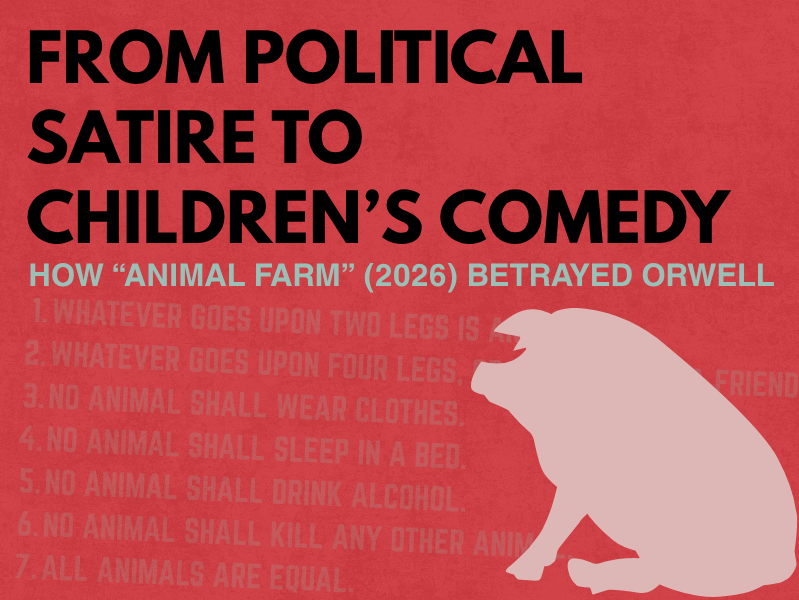
On May 1, 2026, a new rendition of George Orwell’s Animal Farm was released to the moviegoing public by Angel Studios, produced by Imaginarium Productions. Directed by Andy Serkis and written by Nicholas Stoller, the movie features well-known stars such as Seth Rogen, Gaten Matarazzo, Kieren Culkin and many others. In the days following the release, many fans of the original Animal Farm story were left feeling disappointed in the film’s final product.
Serkis’ adaptation of “Animal Farm” feels less like an interpretation of Orwell’s political allegory and more like an attempt to turn a brutal warning about authoritarianism into a marketable children’s comedy. While there are brief flashes of competence scattered throughout the roughly 90-minute movie, nearly every creative decision undermines what made Orwell’s original story timeless.
The glaring differences become even more apparent when comparing the movie to the original animated adaptation. The 1954 version altered some aspects of the original ending, but it still respected the story’s oppressive atmosphere. The animation was limited, yet the filmmakers understood that “Animal Farm” should feel grim and emotionally draining. In contrast, Imaginarium Production’s adaptation looks and feels like a generic animated comedy wearing Orwell’s story as a disguise.
One of the most pressing issues is the movie’s confusing tone. Orwell’s novel is deliberately bleak, forcing attention to how revolutions can become corrupted and how propaganda destroys truth over time. The book builds slowly toward the realization that the pigs have become completely indistinguishable from the oppressors they replaced. The 2026 film, however, constantly interrupts this tension with new scenes of exaggerated humor, fast-paced action scenes and jokes that feel designed for young viewers. Instead of letting the audience sit with the horrors of authoritarianism, the movie continuously tries to reassure watchers that everything is still fun.
This film weakens the original story by shifting attention away from the plot and toward Lucky, a younger pig protagonist created specifically for this adaptation. Lucky is a piglet who becomes corrupted under the influence of Napoleon, and is later the one who brings the tyrant to his demise. The creators effectively centered the narrative around Lucky and his feelings, rather than each of the animal’s roles in the overall story. Orwell’s novel works because the “main character” is the revolution itself. The tragedy of the original is formed by watching the collective ideals of Animalism collapse into tyranny. By introducing a traditional heroic protagonist, the movie simplifies the story into a predictable children’s narrative. Instead of trusting the audience to understand Orwell’s political themes, Serkis and Stoller’s script overexplains everything and removes the moral ambiguity that made the novella so impactful.
Visually, the movie is inconsistent. Some environmental shots are genuinely beautiful, especially scenes involving the farm landscape and night-time lighting. Many of the scenic backgrounds are reminiscent of Blue Sky Studios’ “Ferdinand,” with beautiful blending and detailed nature. Some sequences show real artistic effort, but the character animation often feels strangely lifeless in comparison. The animals lack the expressive weight necessary for a story built around betrayal, fear and exhaustion. In the 1954 adaptation, even basic facial expressions and shadow-heavy compositions communicate dread more effectively than the modern 3D-CG version.
The film’s greatest failure is its ending. Orwell’s original conclusion is devastating because the animals realize “they looked from pig to man, and from man to pig, and from pig to man again; but already it was impossible to say which was which.” That line is the pinnacle of “Animal Farm”, where it’s demonstrated the revolution failed because power corrupted the revolutionaries completely. The 2026 adaptation softens this conclusion into something far more optimistic and emotionally comforting which completely eviscerates the impact of Orwell’s message.
One of the decent aspects of the movie is Seth Rogen’s performance as Napoleon. Rogen occasionally captures the smug manipulation and eerie cruelty that the character should have, but there are moments where his line delivery hints at the calculating dictator Orwell created. Unfortunately, the screenplay never allows Napoleon to become truly terrifying because the film continuously interrupts pivotal moments with comedy or emotional shortcuts.
What makes this version especially disappointing is that there are brief moments where a stronger movie almost appears. Boxer’s storyline occasionally carries emotional weight, and a few propaganda scenes resemble the manipulative atmosphere of Orwell’s novel. But every time the film gets close to saying anything meaningful, it retreats into cartoon humor or spectacle.
Ultimately, “Animal Farm” (2026) feels less like an adaptation of Orwell’s work and more like a heavily diluted version, designed to avoid challenging its audience. Aside from some attractive environmental animation and Seth Rogen’s occasionally effective performance, I found the film hollow, tonally confused and emotionally weak. Compared to both the original novel and the 1954 animated adaptation this version lacks the bitterness and political sharpness that made Animal Farm matter in the first place. It turns a brutal warning about authoritarianism into a forgettable family entertainment, and in doing so, it completely loses the point.